.png)
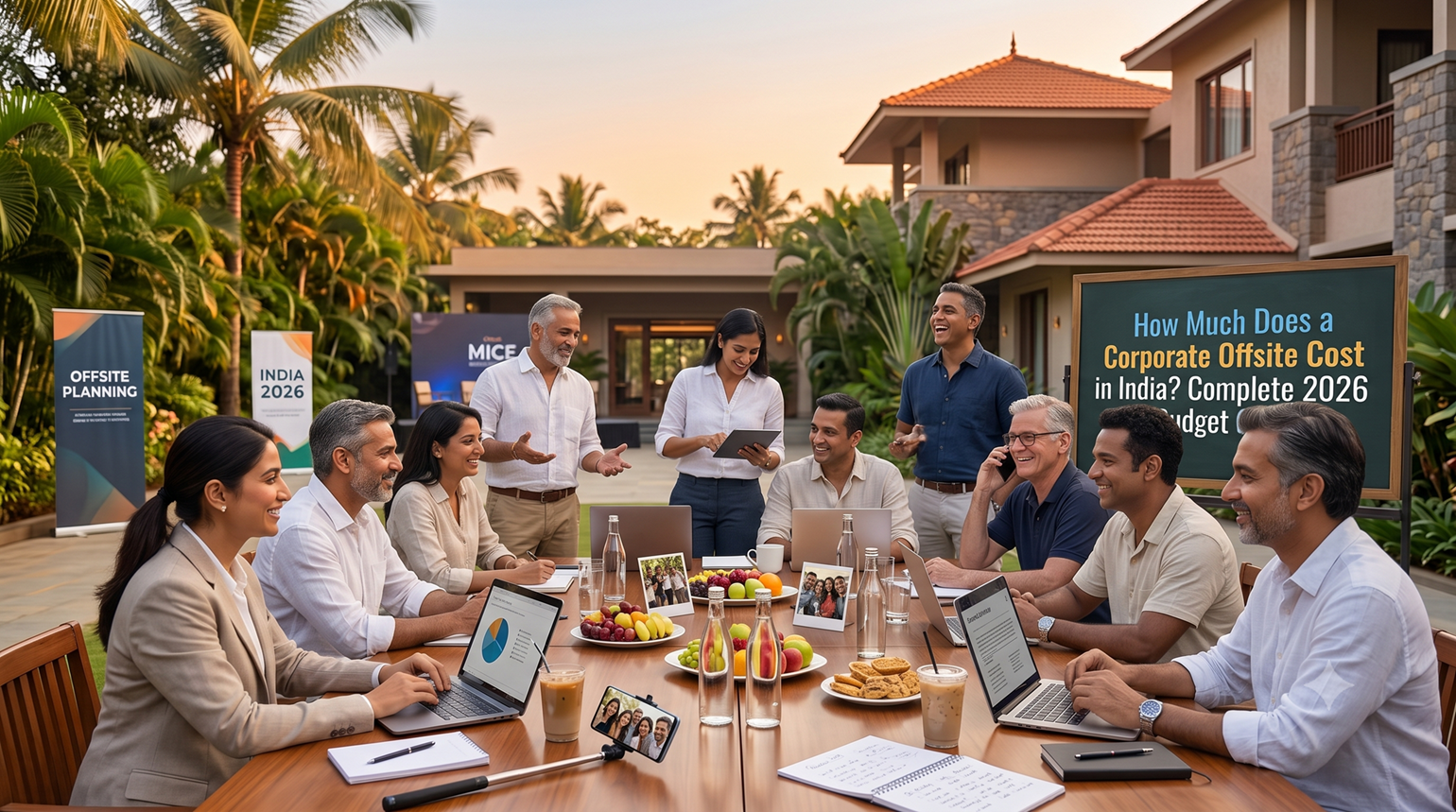
How Much Does a Corporate Offsite Cost in India? Complete 2026 Budget Guide
Budgeting for a company retreat used to be a matter of picking a nice resort, booking a banquet buffet, and tallying room nights on an Excel sheet. That model is officially broken.
In 2026, offsites are no longer treated as casual vacations disguised as work. For distributed and hybrid teams, retreats are high-leverage strategic investments designed to solve real business bottle necks: cross-functional alignment, strategic quarterly planning, cultural cohesion, and attrition reduction.
Yet, when founders, People Ops leads, and Chief of Staff step into planning, the initialprojection rarely matches the final invoice. The primary culprit? The notorious 20% to 30% hidden cost gap—ancillary charges like AV fabrication, lawn sound permits, gala corkage fees, last-milelogistics, and differential GST slabs that rarely show up in standard hotelproposals.
Whether you are planning a 20-person executive council or a 250-employee annual company gathering, this guide breaks down real-world MICE pricing, itemized budget buckets, regional differences across India, and tactical frameworks to optimize spend without sacrificing experience.
1. Corporate Offsite Cost Tiers at a Glance
To build anaccurate projection, you need a base line per-person, per-day (PPPD) metric. This rate includes accommodation, standard corporate meal packages (MAPAI/APAI), conference facilities, basic AV, and group engagement activities. It excludes long-distance transit (flights or long-distance train tickets).
Cost Tier: Budget / Driveable
Typical Daily Rate (Per Person / Day): ₹5,000 – ₹9,500
Accommodation & Venue Type: 3-star / Business hotel / Regional resort within 3–4 hrs drive
Best Suited For: High-frequency hackathons, small team sprints, regional sales huddles
Key Inclusions: Twin-sharing rooms, basic conference hall, buffet meals, in-house team activities
Cost Tier: Mid-Range Experience
Typical Daily Rate (Per Person / Day): ₹10,000 – ₹21,000
Accommodation & Venue Type: 4-star upscale / Premium boutique resort / Heritage retreat
Best Suited For: All-hands retreats, annual company summits (50–150 pax)
Key Inclusions: Twin/single mix, MAPAI/APAI meal plan, dedicated LED/AV setup, 1 curated gala dinner, professional facilitator
Cost Tier: Leadership & Premium
Typical Daily Rate (Per Person / Day): ₹20,000 – ₹48,000+
Accommodation & Venue Type: 5-star luxury / Heritage palace / Ultra-luxury beach villa
Best Suited For: CXO strategy sessions, VIP incentive trips, founder retreats
Key Inclusions: Single occupancy, high-end experiential dining, external executive coaches, premium sound/stage fabrication, bespoke gifting
2. End-to-End Offsite BudgetAllocation Breakdown
Before diving into individual line items, look at how an enterprise-grade offsite budget typically splits across core operational buckets:
· Accommodation & Conference Halls (42%): Room inventory, main conference rooms, breakout areas, and day delegatecharges.
· Food, Beverage & Gala Dinners (24%): Full-board meal plans, evening cocktail setups, corkage fees, and live food counters.
· Travel & Last-Mile Logistics (16%): Luxury coach charters, airport-to-hotel shuttles, tolls, and inter-venuetransits.
· AV Production, Sound & Staging (9%): High-lumen LED walls, line-array audio rigs, ambient stage lighting, and branding backdrops.
· Facilitators & Experiences (5%): External keynote speakers, behavioral trainers, experiential workshops, andcurated team games.
· Contingency & Incidentals (4%): Unplanned mini-bar usage, late checkout buffers, local government permissions,and medical reserves.
3. Detailed Line-Item Cost Decomposition
Understandingwhere your money goes prevents mid-planning surprises. Here is how standardhotel contracts translate to real-world expenses.
A. Accommodation & Meal Plans (EP vs. CP vs. MAPAI vs. APAI)
Never book a corporate offsite on an EP (European Plan - Room Only) or CP (Continental Plan - Room + Breakfast) basis. When 80 team members order room service or à la carte club sandwiches, your budget will explode on day one.
· APAI (American Plan All Inclusive): Covers room, breakfast, lunch, high tea, and dinner. This is the industry standard for retreats where teams stay on property all day.
· MAPAI (Modified American Plan All Inclusive): Covers room, breakfast, high tea, and one major meal(usually lunch or dinner). Best suited if your team is exploring local diningor organizing an off-property excursion.
· Day Delegate Rate (DDR): If local employees join without staying overnight, hotels charge a DDR (typically ₹1,000to ₹4,200 + taxes), which covers banquet space, tea breaks, and the lunchbuffet.
B. Travel & Last-Mile Logistics
Travel often carries the highest risk of cost escalation due to dynamic pricing.
· Commercial Flights: For pan-India teams converging in hubs like Goa or Jaipur, flights must be locked 60 to 90 days out. Budget ₹8,000 to ₹14,000 per person round-trip.
· Chartered AC Coaches (Volvo / BharatBenz): Essential for point-to-point transfers (e.g., Delhi to Jim Corbett, Mumbai toLonavala, Bengaluru to Coorg). A 45-seater Volvo averages ₹30 to ₹50 perkilometer, with driver allowances and state boundary toll taxes adding ₹4,000to ₹8,000 per journey.
· Airport-to-Resort Shuttles: Moving 100 people arriving on 8 different flights requires staggered Innova Crysta or Tempo Traveller rotations. Budget ₹1,200 to ₹2,500 per transfer depending ondistance.
C. Banqueting, F&B, and Evening Events
Standard buffet dinners are covered under your APAI plan, but an offsite need at leastone signature evening:
· Gala Dinner Surcharges: Expect anupsell of ₹1,000 to ₹2,800 per plate above the standard buffet to add livecounters, barbecue, and extended dessert spreads.
· Corkage Fees & Bar Setups: Hotels charge ₹1,000 to ₹2,500 per bottle for outside liquor, or a flatbar-setup fee ranging from ₹25,000 to ₹60,000 per night.
· Excise & PPL/IPRS Licenses: If you are playing commercial music or serving alcohol on a lawn or banquet hall,state excise permits and music licenses (PPL/IPRS) cost between ₹15,000 and₹45,000 depending on the state.
D. Conference Production & Audio-Visuals (AV)
Relying on"in-house resort AV" is a common trap. In-house resort equipmentoften consists of a washed-out projector and a single collar mic meant forbasic meetings.
· P3 LED Video Wall (12x8 ft or 16x9 ft): ₹20,000 – ₹50,000 per day.
· JBL Line Array Sound System + Digital Mixer: ₹12,000 – ₹30,000 per day (mandatory for audiences over 60 people or outdoorlawns).
· Stage Fabrication & Backdrop:₹12,000 – ₹40,000 depending on branding and framing.
· High-Speed Dedicated Wi-Fi Line: Never trust open hotel Wi-Fi for 100 laptops. Securing a dedicated 100 Mbpspipeline often costs an additional ₹10,000 to ₹35,000 per event.
E. Team Engagement, Facilitation & Wellness
· Professional Corporate Facilitators: Engaging an experienced external facilitator for hackathons, behavioural simulations, or leadership workshops ranges from ₹50,000 to ₹2,00,000 per day.
· Experiential Local Workshops: Pottery sessions, culinary cook-offs, guided estate walks, or drum circles runbetween ₹500 and ₹2,200 per participant.
4. Destination Cost Benchmarks Across India
Locationdictates both the base cost and the logistical friction of your offsite.
Destination Routing Decision Tree:
· Route A:Driveable Destinations (Within 3–4 Hours by Fleet Coach)
o North Hubs: Jim Corbett, Neemrana, Rishikesh
o West Hubs: Lonavala, Alibau g
o South Hubs: Coorg, Kabini, Mahabalipuram
· Route B: Flight-Assisted Hubs (Pan-India Connectivity Required)
o North Heritage: Jaipur, Udaipur, Srinagar
o West Coastal: Goa (North for vibrant social life, South for quiet retreats)
o South Coastal/Backwaters: Kochi, Kumarakom
Region: North
Popular Destinations: Jim Corbett, Rishikesh
Average 2-Night / 3-Day Package Cost (Per Person) *: ₹12,000 – ₹24,000
Best Season for Optimal Rates: July – Oct, Feb – March
Logistical Difficulty: Moderate (Driveable from NCR)
Region: North
Popular Destinations: Jaipur, Neemrana, Udaipur
Average 2-Night / 3-Day Package Cost (Per Person) *: ₹15,000 – ₹38,000
Best Season for Optimal Rates: April – September (Off-season deals)
Logistical Difficulty: Low to Moderate
Region: West
Popular Destinations: Lonavala, Alibaug
Average 2-Night / 3-Day Package Cost (Per Person) *: ₹10,000 – ₹25,000
Best Season for Optimal Rates: Mid-week all year; Monsoon rates
Logistical Difficulty: Low (Driveable from Mumbai/Pune)
Region: West
Popular Destinations: Goa (North vs. South)
Average 2-Night / 3-Day Package Cost (Per Person) *: ₹17,000 – ₹42,000
Best Season for Optimal Rates: May – September (Shoulder season)
Logistical Difficulty: Low (Direct flights nationwide)
Region: South
Popular Destinations: Coorg, Kabini, Ooty
Average 2-Night / 3-Day Package Cost (Per Person) *: ₹15,000 – ₹28,000
Best Season for Optimal Rates: June – October
Logistical Difficulty: Moderate (Driveable from BLR/HYD)
Region: South
Popular Destinations: Mahabalipuram, Puducherry
Average 2-Night / 3-Day Package Cost (Per Person) *: ₹14,000 – ₹26,000
Best Season for Optimal Rates: Year-round; avoid peak summer
Logistical Difficulty: Low (Close to Chennai airport)
Note: Figures includetwin-sharing upscale stay, all meals, conference facility, production, andairport/hub coach transfers. Excludes commercial airfare.
5. Hidden Costs, Tax Traps, and Contract Clauses
Small line items in hotel contracts can quietly add significant amounts to your finalbill:
The Differential GST Trap
Hospitality tax in India is fragmented across distinct slabs:
· Hotel RoomTariffs: Slabs are pegged directly to the declared room rate (12% for rooms below ₹7,500; 18% forrooms above ₹7,500).
· Restaurant & Food Services: Standard 5% without Input Tax Credit (ITC) or 18% with ITC if bundled undercomposite banquet contracts.
· Banquet, Lawn & Conference Rentals: Charged at a flat 18% GST.
· Outdoor Production & Event Services: Charged at 18% GST.
· Liquor Taxes: VAT and state levies are non-creditableand vary state to state (typically 20% to 25%).
Hotel Contract Gotchas
· Minimum Guarantee (MG): If you sign an MG for 100 people and only 82 show up due to last-minute workload orillness, you still pay for 100. Always negotiate a 10% to 15% attrition cushion up to 14 days beforecheck-in.
· Early Check-in / Late Check-out Penalties: Team flights often land at 9:00 AM, but standard hotel check-in is 2:00 PM or3:00 PM. If you require rooms immediately, hotels charge 50% to 100% of theroom rate. Workaround: Book a holding banquet hall for luggage, refresh kits, and breakfast whilerooms are readied.
· Power Backup (DG Set Charges): High-power LED walls and outdoor sound systems exceed standard hotel line power. Resorts often charge an unannounced ₹2,000 to ₹5,000 per hour forrunning heavy-duty diesel generators.
6. How to Optimize Your Offsite Budget by 25%
Slashing costs does not mean picking a low-quality venue or cutting back on food. It isabout restructuring your schedule and vendor contracts.
The Core Optimization Levers:
1. Shift to Mid-Week (Tuesday to Thursday) ➔ Unlocks 20% to 30% Tariff Savings
Business and leisure resorts charge peakpricing Friday through Sunday. Shifting your schedule eliminates leisure-crowdmarkups and ensures your team gets full property focus.
2. Select Driveable Hubs (3–4 Hours Out) ➔ Eliminates 30% to 40% Transit Costs
Removing commercial flights lets youredirect significant capital into premium dining, executive coaches, andhigh-impact workshop facilitators.
3. Consolidate with an End-to-End MICE Partner ➔ Maximizes Volume Leverage & Single GST Filing
Sourcing hotels, fleet transport, sound systems, and activity anchors separately triggers multiple individual retailmargins. Partnering with a specialized team gives you institutional pricing andconsolidated tax credits.
7. The 2026 Corporate Offsite Budget Formula
Tocalculate your total estimated budget before requesting proposals, use this framework:
Total Budget = (Attendees × Days × DailyRate) + Transit Costs + Production Costs + Miscellaneous + Buffer
Where:
· Attendees: Total number of participating employees.
· Days: Total count of event days and nights.
· Daily Rate: Benchmark per person/day (₹6,000 for Budget, ₹12,000 for Mid-tier, ₹25,000 for Premium).
· Transit Costs: Commercial airfare tickets or Volvo/coach fleet rentals.
· Production Costs: Dedicated LED screens, staging, audio rigs, and branded backdrops.
· Miscellaneous: Welcome kits, speaker fees, state excise permits, and activity entries.
· Buffer: A mandatory 10% contingency reserveset aside for on-ground incidentals and hotel minibar clearances.
8. Measuring Retreat ROI: Proving the Value to Finance
An offsite should never end with just photographs and tired attendees. To justify the budget to your leadership team and finance department, tie the retreat to measurable business outcomes:
· Post-Retreat Alignment Index: Run ananonymous survey 7 days after the retreat measuring strategic clarity and teamconnection against pre-retreat benchmarks.
· Sprint Velocity & Cross-Team SLAs: Monitor whether inter-departmental friction points identified during the offsite lead to measurable workflow improvements over the following two quarters.
· Retention Tracking: Track voluntary attrition rates within teams that attended dedicated culture oralignment offsites compared to historical cohorts.
Plan Your Next Offsite with HiOffsite
Planning a high-impact corporate retreat shouldn't require your People Ops team to spend 60 hours chasing resort managers and transport vendors.
At HiOffsite, we engineer corporate offsites, leadership retreats, and annual summits across India’s best properties. From venue sourcing and production management to team experiencesand on-ground logistics, we handle the details so you can focus on your people.
Explore venues andcalculate your custom retreat budget with HiOffsite →
.png)
.jpeg)