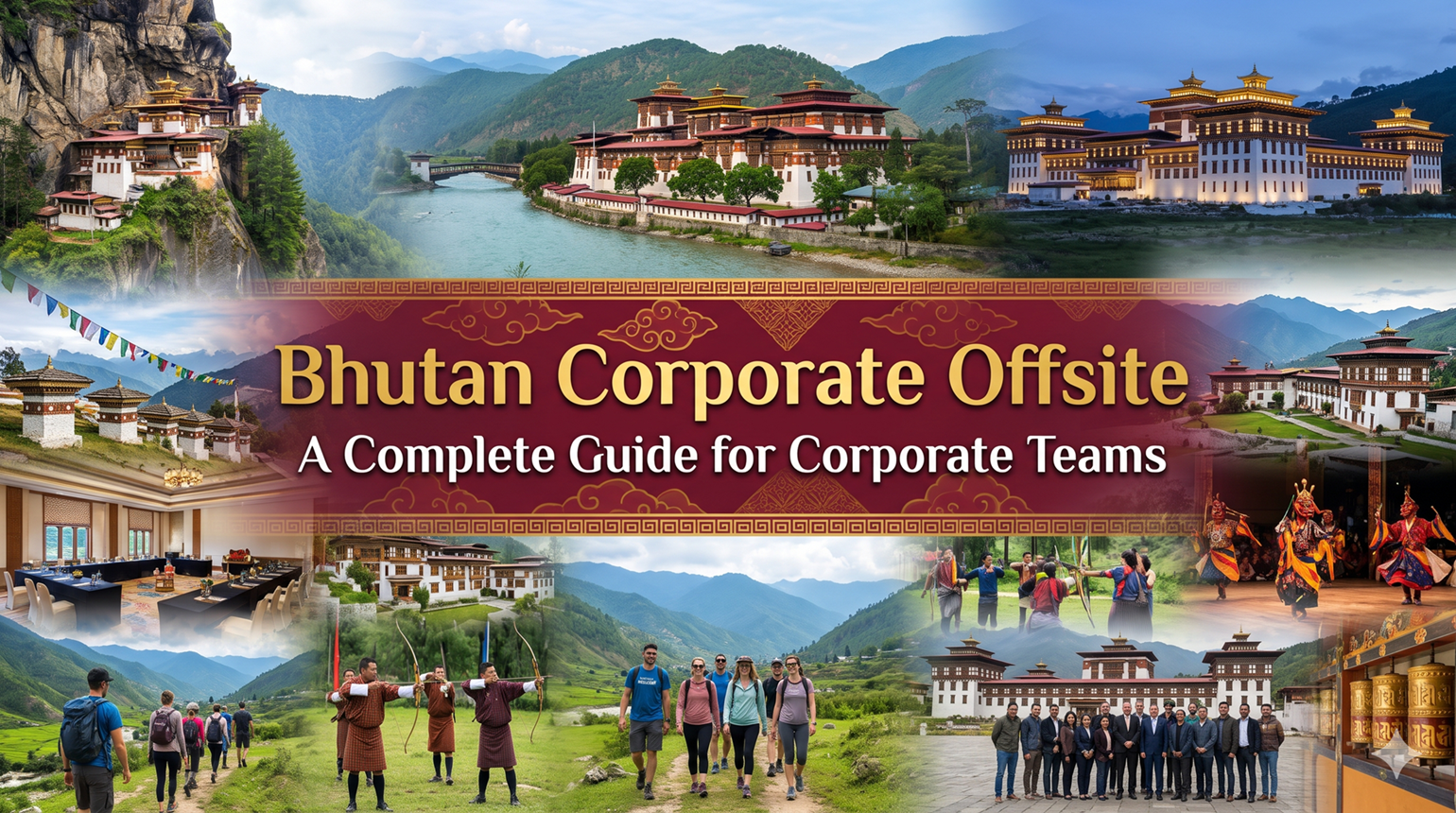
Bhutan Corporate Offsite: A Complete Guide for Corporate Teams
There is a defining moment as your aircraft banks sharply through a narrow Himalayan valley, wings skimming emerald pine ridges before touching down on the short runway at Paro. When the cabin doors open, the crisp, thin mountain air smells faintly of woodsmoke and cypress - and the mental noise of quarterly targets, back-to-back video calls, and metropolitan rush simply vanishes.
For Indian organizations looking to step entirely outside conventional corporate routines, a Bhutan corporate offsite delivers an unmatched psychological reset. Bhutan is not a high-volume tourist hub; it is a carbon-negative Himalayan kingdom governed by Gross National Happiness, where billboards are banned, pristine valleys remain unspoiled, and architectural heritage is woven into every modern hotel.
Yet, organizing a company retreat in Bhutan requires navigating specific operational realities that differ sharply from standard domestic or Southeast Asian destinations. Bhutan operates under a strict High Value, Low Volume tourism framework. Managing the mandatory Sustainable Development Fee (SDF), coordinating advance entry permits through licensed operators, planning around mountain road drive times, and selecting venues with genuine conference infrastructure require disciplined upfront logistics.
Whether you are assembling a 15-person leadership board for multi-year strategic planning or bringing together 80 colleagues for an annual company summit, here is your comprehensive guide to executing a high-yield corporate offsite in Bhutan.
Why Bhutan Works: The Strategic Case for the Himalayan Kingdom
When finance teams and executive sponsors weigh international retreat options, Bhutan offers a distinct combination of proximity, prestige, and deep organizational focus:
- Short-Haul Proximity with Total Immersion: Located just a 2-hour and 20-minute direct flight from New Delhi or a 1-hour hop from Kolkata, Bagdogra, and Guwahati, Bhutan places your team in a dramatically different world without exhausting long-haul travel or severe jet lag (Bhutan Standard Time is only 30 minutes ahead of IST).
- Natural Containment & Zero Urban Distraction: With no sprawling shopping malls, loud commercial nightlife, or chaotic traffic, teams naturally remain unified. Strategic discussions continue organically over butter tea on cedar-wood decks, during valley walks, and around evening courtyard fire pits.
- Built-In Cultural & Wellness Depth: Bhutan’s living Buddhist heritage, traditional archery grounds, hot-stone bathhouses (Dotsho), and pristine forest trails provide authentic, reflective experiences that encourage candid communication and genuine human connection.
- Simplified Currency & Cultural Warmth: The Bhutanese Ngultrum (BTN) is pegged 1:1 with the Indian Rupee (INR), and Indian currency is widely accepted across the kingdom, eliminating complex foreign exchange conversions for everyday expenses.
Entry & Regulatory Framework: What Corporate Planners Must Know
Unlike casual cross-border trips, traveling to Bhutan requires formal pre-clearance. Outdated assumptions—such as assuming Indian citizens can simply drive across the border with zero advance paperwork - can stall an entire corporate group.
1. The Sustainable Development Fee (SDF) for Indian Nationals
Under Bhutan’s bilateral friendship arrangement, Indian citizens receive a substantial concession compared to international USD-paying tourists, though the daily levy remains mandatory for every night spent in the kingdom.
- The Rate: ₹1,200 per person, per night (confirmed unchanged through August 31, 2027).
- How It Works: The SDF is calculated strictly on the number of nights stayed - not days - and is paid upfront online during the permit approval process. Note that this fee goes directly toward Bhutan’s healthcare, education, and environmental conservation programs; it does not cover hotels, meals, or transport.
- GST Rule Update: Tour packages, local vehicle charters, and hotel bookings inside Bhutan carry a 5% Goods and Services Tax (GST), while the government SDF levy itself is exempt from GST.
2. Entry Permits & Documentation
Indian citizens do not require a traditional visa, but every traveler must hold an approved Entry Permit issued by Bhutan’s Department of Immigration prior to arrival.
- Accepted IDs: A valid Indian Passport with at least 6 months of remaining validity from the intended date of departure from Bhutan, OR an original Voter ID card (passports are strongly recommended for smooth airport check-in on Drukair and Bhutan Airlines).
- Processing Channel: Permits must be processed online in advance through a Department of Tourism-licensed Bhutanese tour operator or certified corporate travel partner alongside confirmed hotel bookings and SDF payment.
3. Aviation & Flight Block Reality
Paro International Airport (PBH) is the kingdom’s sole international gateway, serviced exclusively by Drukair (Royal Bhutan Airlines) and Bhutan Airlines.
- Direct Hubs: Direct flights operate from New Delhi (DEL), Kolkata (CCU), Bagdogra (IXB), and Guwahati (GAU).
- Flight Timing Rule: Because Paro is surrounded by 18,000-foot Himalayan peaks, flights operate strictly under Visual Flight Rules (VFR) during daylight hours - meaning landings and takeoffs occur in the morning and early afternoon. Always book morning flight blocks and build a comfortable buffer on your final departure day.
Mapping the Valleys: The 3 Primary Retreat Corridors
Bhutan’s western tourism circuit connects three distinct valleys via scenic mountain highways. Because mountain roads wind through high passes, choosing one or two bases - rather than attempting an exhaustive cross-country road tour—is essential for keeping team energy high.
1. Paro Valley: The Scenic Gateway & Heritage Heart
Sitting at 7,200 feet, Paro is a wide, flat river valley framed by terraced rice paddies, weeping willows, and ancient fortress-monasteries (Dzongs).
- The Working Atmosphere: Tranquil, historic, grounded, and accessible.
- The Logistical Advantage: Located within 10 to 25 minutes of Paro Airport, eliminating long post-flight coach journeys. Paro houses Bhutan’s highest concentration of ultra-luxury lodges alongside mid-sized corporate resorts, making it ideal for 3-night retreats where minimizing road transit is a priority.
- Best Suited For: Executive leadership retreats, CXO strategy boards, founders' councils, and mid-sized company summits (15 to 100 attendees).
2. Thimphu Valley: The Capital & MICE Hub
Located roughly 50 kilometers east of Paro (a smooth 1- to 1.5-hour drive along the Paro Chhu and Wang Chhu rivers), Thimphu is the world’s only national capital without traffic lights.
- The Working Atmosphere: Vibrant, cultural, executive-ready, and scaled.
- The Logistical Advantage: Thimphu features Bhutan’s largest inventory of hotel rooms, dedicated pillarless banquet halls, and audio-visual capabilities capable of hosting larger corporate gatherings, alongside walkable craft markets and modern cafés.
- Best Suited For: Annual sales kick-offs, regional conventions, and company-wide all-hands offsites (60 to 200+ attendees).
3. Punakha Valley: The Subtropical River Sanctuary
Positioned across the 10,170-foot Dochula Pass (roughly 2.5 to 3 hours east of Thimphu), Punakha drops down to a warmer, lush elevation of 4,000 feet where the Mo Chhu and Pho Chhu rivers converge.
- The Working Atmosphere: Lush, warm, restorative, and inspiring.
- The Logistical Advantage: Offers dramatic river-valley scenery, luxury tented camps, and white-water rafting opportunities. Best included as a second-leg stop on a 4-night, 5-day retreat for leadership teams seeking deep decompression.
- Best Suited For: High-trust leadership cohorts, creative strategy sprints, and reward retreats (15 to 50 attendees).
Vetted Properties: Where Himalayan Calm Meets Business Infrastructure
A productive corporate offsite requires more than scenic mountain views; it demands reliable heating, dedicated backup generators, strong leased-line Wi-Fi, and functional meeting spaces. Here are properties that consistently deliver for corporate groups:
For Scaled Summits & Enterprise MICE (60–200+ Pax)
- Le Méridien Thimphu (Thimphu): Positioned in the heart of the capital, Le Meridien blends contemporary luxury with traditional Bhutanese woodwork. It features dedicated pillarless banquet halls, breakout meeting rooms, an indoor heated pool, and experienced catering teams capable of executing Indian and international corporate buffets.
- Taj Tashi, Thimphu: Blending traditional Dzong architecture with modern luxury, Taj Tashi offers 66 spacious rooms, versatile conference halls, and IHCL’s renowned service standards - providing familiar culinary comfort and reliable execution for corporate delegations.
- Le Méridien Paro, Riverfront: Set along the banks of the Paro River just 10 minutes from the airport, this property features expansive glass-walled lounges, modern meeting facilities, and sweeping valley views, making it an effortless base for mid-to-large corporate groups.
For Boutique Leadership Retreats & Mid-Sized Teams (25–60 Pax)
- Zhiwa Ling Heritage (Paro): A wholly Bhutanese-owned luxury hotel crafted with intricate hand-carved timber, stone masonry, and a serene meditation house. Its dedicated conference hall and tranquil courtyard gardens provide an inspiring, authentic setting for leadership alignment and product strategy sessions.
- Naksel Boutique Hotel & Spa (Paro): Perched high on the edge of the Ngoba forest above Paro Valley, this community-centered eco-luxury retreat offers panoramic views of Mount Jomolhari, intimate meeting rooms, and quiet forest trails ideal for focused cohorts.
- Dhensa Boutique Resort (Punakha): Tucked into a pine forest overlooking the Punakha Valley, Dhensa combines minimalist design with private balconies, wellness facilities, and serene breakout spaces for creative teams.
For Ultra-Luxury CXO Councils & Founders' Boards (10–30 Pax)
- Six Senses Bhutan (Paro, Thimphu & Punakha Lodges): Comprising five intimate, architectural lodges across the valleys, Six Senses sets the regional benchmark for high-touch executive wellness, bespoke private dining, and secluded strategic retreats.
- Amankora (Paro, Thimphu & Punakha): Minimalist, monastic-inspired luxury pavilions hidden within pine forests, offering absolute privacy, white-glove service, and intimate library spaces for confidential board discussions.
- Pemako Punakha: Set beside the Mo Chhu river and accessed via a private suspension bridge, featuring luxury tented pool villas, riverside dining, and an extraordinary natural setting for executive renewal.
5 Purposeful Team Experiences That Build Real Alignment
High-performing teams resist generic icebreakers and artificial corporate games. Bhutan’s living traditions and rugged mountain terrain provide natural settings for shared experiences that foster trust and collaboration:
1. Traditional Bhutanese Archery (Dha) Tournament
Archery is Bhutan’s national sport, deeply woven into community life and celebrations.
- The Dynamic: Under the guidance of local archery masters on a private resort range, cross-functional squads learn to string and draw traditional bamboo bows alongside modern compound bows, aiming at wooden targets placed up to 100 meters away. Each hit is celebrated with traditional synchronized singing and dancing (Zhey) led by local hosts.
- The Business Impact: Demands calm breathing, focus under friendly peer pressure, and collective celebration - leveling corporate titles in minutes.
2. The Tiger’s Nest (Paro Taktsang) Collaborative Ascent
Climbing to the cliffside monastery perched 3,000 feet above the Paro Valley floor is a defining shared milestone.
- The Dynamic: Rather than turning the 4- to 5-hour round-trip hike into an individual race, pair colleagues in cross-departmental buddy groups supported by experienced local mountain guides. Teams pace each other up the pine-shaded trail, pausing at the halfway cafeteria deck overlooking the cliff face for a guided reflection exercise.
- The Business Impact: Overcoming a physical mountain challenge together builds deep mutual respect, empathy, and conversational openness that carries straight back into daily work.
3. Dochula Pass Prayer Flag Hoisting & Vision Circle
At 10,170 feet along the mountain pass separating Thimphu and Punakha, 108 memorial stupas (Druk Wangyal Chortens) overlook the snow-capped eastern Himalayas.
- The Dynamic: Guided by a local cultural host, teams participate in a traditional ceremony hoisting custom-printed prayer flags symbolizing goodwill, clarity, and collective strength, followed by a brief outdoor leadership address on organizational purpose.
- The Business Impact: Anchors annual company goals in a memorable, elevated setting that inspires long-term thinking.
4. Traditional Ema Datshi & Momos Culinary MasterChef Sprint
Bring team dynamics into Bhutanese culinary traditions.
- The Dynamic: Set up outdoor cooking stations on a resort lawn. Squads receive crates containing local red rice, organic mountain cheeses, mild and fiery chilies, buckwheat flour, and fresh forest herbs. Guided by resort chefs, teams have 75 minutes to prepare and pitch an authentic Bhutanese feast to leadership.
- The Business Impact: Highlights role clarity, time management, and creative collaboration under deadline constraints, finishing with a warm communal meal.
5. Mo Chhu River Rafting & Valley Retrospective (Punakha)
Navigate the clear, glacial waters of the Mo Chhu ("Female River") beneath the towering walls of Punakha Dzong.
- The Dynamic: Six to eight colleagues board each raft guided by certified river captains, paddling through gentle Class II–III rapids. The expedition concludes on a quiet riverside sandbank with hot tea, snacks, and an open-air team retrospective.
- The Business Impact: Synchronized paddling requires real-time coordination, while the tranquil riverbank setting encourages honest, low-ego feedback.
The Strategic 4-Day, 3-Night Run-of-Show
Because mountain road transfers require careful pacing and altitude acclimatization (Paro and Thimphu sit above 7,200 feet), a 3-night, 4-day itinerary balances strategic workshops with restorative downtime:
Day 1: Scenic Arrival, Altitude Acclimatization & The Himalayan Welcome
- 09:30 AM – 12:30 PM: Morning Flight into Paro & Valley Transfer
- Land at Paro International Airport on morning Drukair or Bhutan Airlines flights. Clear immigration with pre-approved permits and board private executive coaches for the scenic drive to your Paro or Thimphu resort.
- 01:00 PM – 03:30 PM: Welcome Lunch & Protected Acclimatization Time
- Enjoy a light, hydrating welcome lunch followed by two hours of unscheduled rest—vital for adjusting smoothly to the 7,500-foot elevation.
- 04:00 PM – 06:00 PM: Session 1 - Plenary State of the Business
- Convene in the main conference hall. Leadership delivers a candid 45-minute overview of company milestones, market headwinds, and the core purpose of the offsite, followed by an open town hall discussion.
- 06:30 PM – 08:30 PM: Courtyard Fire-Pit Sundowner & Cultural Welcome
- Gather around open stone fire pits on the resort lawn. Feature warm spiced cider, local appetizers, and a traditional masked folk dance performance under the stars.
- 08:30 PM – 10:00 PM: Welcome Dinner
- A hearty buffet featuring Bhutanese, Indian, and continental dishes. Keep the evening relaxed with no formal speeches.
Day 2: Strategic Breakouts & Traditional Archery Tournament
- 07:00 AM – 08:00 AM: Optional Sunrise Breathwork & Valley Walk
- A gentle, opt-in morning stretch and guided pine-forest walk to energize early risers.
- 08:00 AM – 09:15 AM: Full Mountain Breakfast Buffet
- Fresh mountain fruits, eggs made to order, hot Indian breakfast options, and freshly brewed coffee.
- 09:30 AM – 12:30 PM: Session 2 - Cross-Functional Problem Breakouts
- Divide into cross-departmental cohorts across breakout suites. Teams tackle key operational bottlenecks and refine quarterly goals, distilling concrete solutions onto shared roadmaps.
- 12:30 PM – 02:00 PM: Working Terrace Lunch
- A clean, protein-forward meal designed to sustain afternoon focus.
- 02:00 PM – 03:45 PM: Session 3 - The Accountability Exchange & Roadmap Pitch
- Cohorts present their action plans back to the room. Department heads negotiate cross-team dependencies live, securing commitments directly on site.
- 04:15 PM – 06:30 PM: The Traditional Bhutanese Archery (Dha) Tournament
- Move outdoors to the resort archery range for a high-energy, cross-functional team competition.
- 07:30 PM – 10:30 PM: Communal Dinner & Hot-Stone Bath (Dotsho) Sign-Ups
- A relaxed evening dinner, with optional traditional herbal hot-stone bath bookings for delegates.
Day 3: The Tiger’s Nest Ascent & The Highland Gala
- 07:00 AM – 08:00 AM: Early Energizing Breakfast
- Fuel up for the morning trek.
- 08:30 AM – 01:30 PM: The Signature Shared Challenge - Tiger’s Nest Hike
- Transfer to the trailhead for the guided ascent to Paro Taktsang (with alternative valley heritage experiences arranged for anyone preferring a gentler pace).
- 02:00 PM – 03:30 PM: Restorative Valley Lunch
- A hearty, well-earned lunch at the base of the valley.
- 03:30 PM – 06:30 PM: Protected Personal White Space & Gala Prep
- Three hours of unscheduled rest - essential for muscle recovery, spa treatments, and dressing for the evening celebration.
- 07:00 PM – 11:00 PM: The Himalayan Awards Gala & Celebration Dinner
- A formal celebration in the decorated banquet hall. Features leadership appreciation, peer-nominated values awards, a multi-course dinner spread, and indoor music.
Day 4: Commitments Circle & Morning Departure
- 07:30 AM – 08:45 AM: Farewell Breakfast
- An unhurried breakfast where colleagues exchange photos and personal reflections.
- 09:00 AM – 10:00 AM: Closing Plenary - The Commitments Circle
- A concise wrap-up session summarizing key decisions and quarterly commitments before heading to the airport.
- 10:30 AM: Room Check-Out & Paro Airport Transfers
- Short coach transfer to Paro Airport for midday outbound flights back to India.
Realistic Cost Benchmarks: Budgeting for Bhutan
Budgeting for a Bhutan corporate offsite requires accounting for the mandatory daily SDF, limited airline seat inventories, local GST, and luxury hotel rates. Below is a realistic per-head investment framework across standard corporate tiers:
1. Ultra-Luxury Executive Tier (Premier Valley Lodges)
- Estimated Investment: Rs. 25,000 to Rs. 55,000+ per attendee, per night (excluding commercial airfare).
- What It Covers: Single-occupancy luxury suites or villas at flagship properties (e.g., Six Senses Bhutan, Amankora, Pemako Punakha), full American Plan (AP) dining, private meeting hall buyouts, dedicated luxury SUV transfers, private cultural ceremonies, and the ₹1,200/night SDF.
- Best For: CXO roundtables, founders' councils, board meetings, and senior leadership alignment.
2. Premium Enterprise MICE Tier (Paro & Thimphu 5-Star Resorts)
- Estimated Investment: Rs. 10,000 to Rs. 20,000 per attendee, per night (excluding flights).
- What It Covers: Single or double-occupancy rooms at established corporate properties (e.g., Le Meridien Paro/Thimphu, Taj Tashi, Zhiwa Ling Heritage), full conference buffet meal plans, dedicated ballroom use, professional AV setups, facilitated team challenges, group coach transfers, and the ₹1,200/night SDF.
- Best For: Annual sales kick-offs, high-growth startup all-hands, and cross-functional company offsites.
3. Contemporary Business & Boutique Hotel Tier
- Estimated Investment: Rs. 6,000 to Rs. 12,000 per attendee, per night (excluding flights).
- What It Covers: Twin-sharing accommodation at reliable 3- to 4-star boutique Bhutanese hotels, heated meeting rooms with projection, buffet dining, licensed guides, group coach transfers, and the ₹1,200/night SDF.
- Best For: Functional team retreats, engineering sprints, and budget-conscious retreats.
Key Budget Allocation Guidelines
- Accommodation, Conference Halls & Meals (45%): Room blocks, heated meeting rooms, full-board dining, and gala banquets (subject to 5% Bhutan GST).
- Commercial Airfare Blocks (25%): Drukair or Bhutan Airlines group fares (typically ranging from ₹24,000 to ₹45,000+ round-trip depending on departure city and season).
- Mandatory SDF & Entry Permits (10%): ₹1,200 per attendee, per night (exempt from GST).
- Ground Logistics, Coaches & Guides (12%): Private executive mountain coaches, licensed Bhutanese guides (mandatory for groups), and luggage vehicles.
- AV Production, Activities & Permits (8%): Sound systems, projection, archery equipment, monastery entry fees, and professional facilitators.
4 Practical Pitfalls to Avoid in Bhutan
Avoid these common operational missteps when organizing a corporate retreat in the Himalayas:
- Delayed Flight Block Reservations:
- Because only two airlines operate narrow-body aircraft into Paro Airport, seat inventory is tightly constrained. Waiting until six weeks before your offsite to book 50 seats often results in split flights across multiple days. Lock in group airline blocks at least 4 to 6 months in advance.
- Over-Packing the Itinerary with Multi-Valley Transfers:
- Trying to cover Paro, Thimphu, Punakha, and Bumthang in a 4-day corporate retreat turns your offsite into an exhausting bus tour. For a 3-night trip, anchor your stay in Paro (or split between Paro and Thimphu) so teams spend their energy on strategy and connection rather than winding mountain roads.
- Ignoring Altitude & Hydration on Day 1:
- Landing at 7,200 feet and immediately launching into intense physical sports or heavy evening drinking causes altitude headaches and fatigue. Keep Day 1 gentle, prioritize warm hydration, and schedule vigorous activities like the Tiger’s Nest trek for Day 3.
- Underestimating Winter Heating & Evening Temperature Drops:
- During peak autumn and winter months (October to March), sunny daytime temperatures of 16°C–20°C plunge below freezing after sunset. Verify that your shortlisted hotel features central heating (not just small portable space heaters) inside both guest bedrooms and conference halls.
Bringing It All Together: The Strategic ROI of a Bhutan Offsite
A corporate offsite in Bhutan is far more than a scenic Himalayan getaway. When planned with clear goals and disciplined logistics, it acts as a rare organizational catalyst. It removes people from relentless digital noise, softens corporate hierarchies, and places teams in an environment built around mindfulness, clarity, and shared purpose.
By pairing focused business workshops with the quiet majesty of Bhutan’s valleys and living heritage, you create an experience that stays with your team long after they return to their desks - aligned on vision, closer as colleagues, and ready to drive your organization forward.
Ready to Plan a Seamless Corporate Offsite in Bhutan?
Take the operational complexity out of your Himalayan retreat planning. From securing Drukair and Bhutan Airlines group seat blocks and negotiating corporate rates at premier Paro and Thimphu resorts to managing SDF permits, heated luxury coaches, AV staging, and curated cultural team challenges - we handle every operational detail from concept to execution.
[Schedule Your Free Bhutan Offsite Strategy Call]
Share your estimated team size, target travel dates, and retreat goals. We will deliver a customized, fully inclusive proposal designed to maximize your budget and impact.