15 Team Building Activities for Groups of 50–100 Employees
There is a specific operational inflection point that happens the moment a company gathering crosses fifty people.
What works effortlessly for a 15-person startup squad - like an intimate fireside chat or a casual round-the-table icebreaker - completely breaks down when you put 80 employees in a single banquet hall or resort lawn. Side conversations multiply, acoustic energy scatters, shy colleagues disappear into the back rows, and bottlenecks form at every activity station.
Planning team building activities for large groups requires an entirely different playbook. At the 50-to-100 employee mark, you are no longer facilitating a single conversation; you are orchestrating a multi-squad ecosystem. If an activity leaves 60 people standing around watching 10 people play, energy crashes within fifteen minutes.
The key to winning at this scale is simultaneous engagement. The best large-group formats break 80 or 100 people into agile, cross-functional pods of 6 to 8 colleagues who compete, collaborate, or build in parallel - before uniting the entire room for a collective finale.
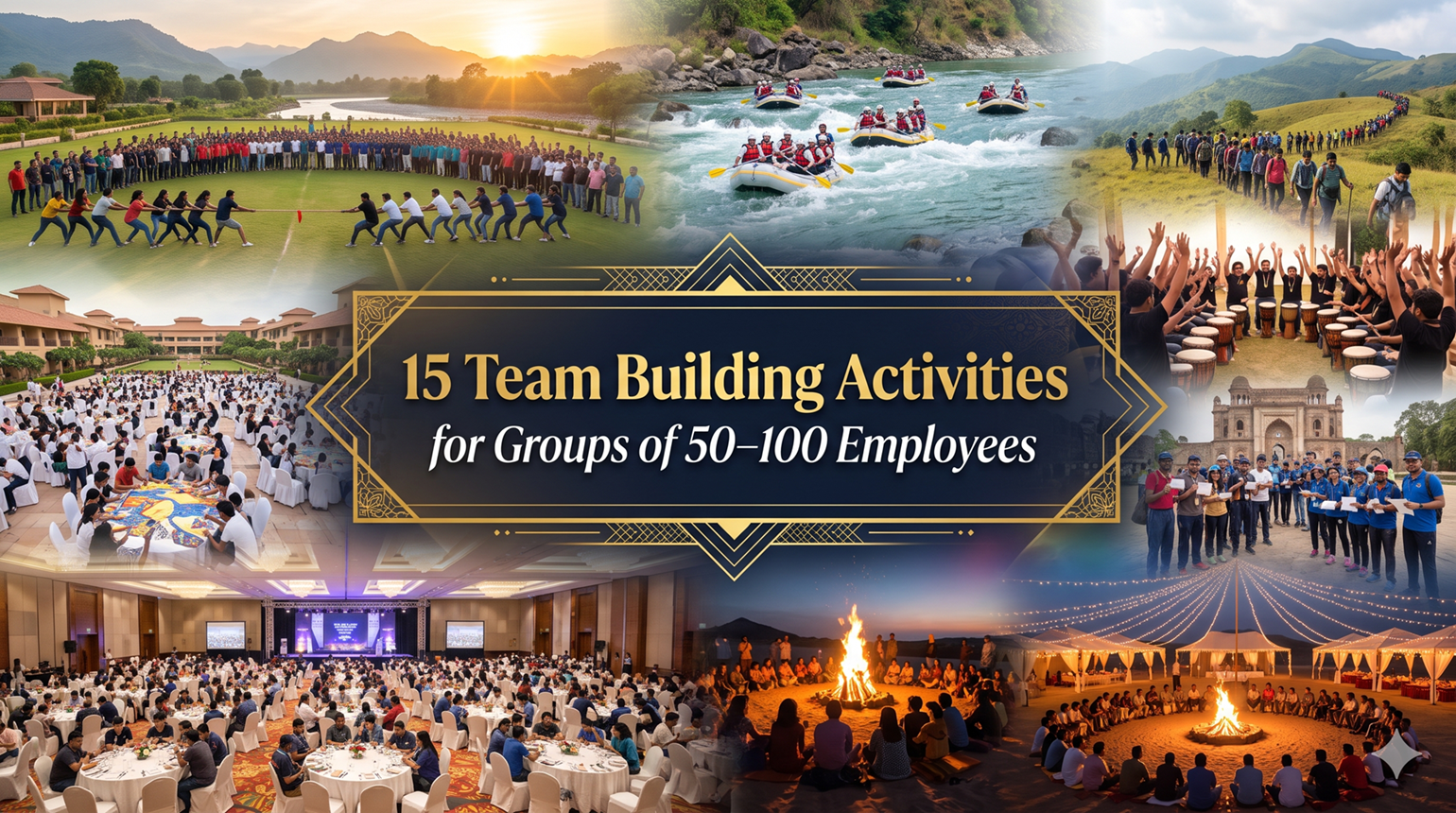
Here are 15 proven, zero-cringe team building activities engineered specifically for groups of 50 to 100 employees, complete with crowd-flow mechanics, space requirements, and the workplace lesson each one unlocks.
Format 1: Synchronized Full-Room Experiences (All 50–100 Active at Once)
These activities keep every single attendee engaged at the exact same second - eliminating queues, waiting lines, and passive spectators.
1. The 100-Piece Orchestral Drum Circle
- Best For: Breaking morning stiffness or energizing an afternoon slump.
- Space & Time: Banquet hall or open lawn | 60 minutes | 8 to 10 squads seated in concentric circles.
- How It Works: Place an authentic African djembe drum or percussion instrument on every chair before guests enter the room. Guided by a professional rhythm facilitator, the entire 80-to-100 person room starts with disjointed, chaotic tapping before gradually locking into synchronized polyrhythms, call-and-response breaks, and tempo shifts.
- Why It Works at Scale: No one is singled out on a stage, making it completely safe for introverts. Hearing 100 colleagues hit a unified beat simultaneously creates an immediate, visceral sense of organizational alignment.
2. The Giant Domino Effect (Chain-Reaction Engineering)
- Best For: Demonstrating cross-departmental handoffs and precision execution.
- Space & Time: Large pillarless ballroom | 90 minutes | 10 to 12 squads of 8.
- How It Works: Divide the room into 10 connected zones along a continuous table or floor track. Each squad receives crates of wooden blocks, ramps, pulleys, marbles, and cardboard tubes. Every team must engineer a mechanical chain reaction inside their zone that triggers the next team’s mechanism - culminating in a single continuous 3-minute run across all 100 employees that hoists a company banner at the finish line.
- Why It Works at Scale: If Squad 4 rushes their build and ignores how their mechanism connects to Squad 5, the entire chain stops. It turns cross-functional dependency into a tangible, high-stakes spectacle.
3. The Collaborative Mural & Masterpiece Grid
- Best For: Visualizing annual company vision and creating an office artifact.
- Space & Time: Conference hall or covered courtyard | 75 minutes | 12 squads of 6 to 8.
- How It Works: A massive corporate artwork representing your company’s mission is divided into 12 separate blank canvas tiles. Each squad receives one tile, acrylic paints, brushes, and a partial coordinate grid - without seeing the full master picture. Teams must communicate across borders to match edge lines and color tones. When all 12 tiles are mounted together on a main stage frame, the unified image is revealed.
- Why It Works at Scale: Keeps 80+ people creatively occupied in parallel while proving how individual departmental deliverables fit into the broader company picture.
4. Interactive Live Quiz Showdown (Fast-Paced Pub Trivia Edition)
- Best For: Evening networking without loud DJ fatigue.
- Space & Time: Ballroom or dining lounge | 60 minutes | 10 to 12 mixed tables of 8.
- How It Works: Ditch slow paper questionnaires for a live, buzzer-backed multimedia quiz hosted on a main LED screen. Mix rapid-fire pop culture, regional trivia, visual riddles, and quirky company history questions. Include lightning bonus rounds where tables send one representative forward for 30-second physical mini-challenges.
- Why It Works at Scale: Keeps every table debating together in real time while maintaining high energy across a large dining room.
Format 2: Multi-Station Rotational Circuits (Zero Bottlenecks)
When running outdoor or physical challenges for 70 to 100 people, a single obstacle course creates long lines. Rotational circuits divide the group into 8 to 10 teams that rotate simultaneously through timed 15-minute stations.
5. The Corporate Pentathlon: Desi Street Olympics
- Best For: High-energy afternoon bonding at resort lawns or sports turfs.
- Space & Time: Open lawn or turf | 2 hours | 10 squads rotating across 5 dual-team arenas.
- How It Works: Set up five head-to-head stations running simultaneously: Lagori (Seven Stones), giant multi-person ski-walk races, tug-of-war, blindfolded obstacle navigation, and quirky gully box-cricket (where batters must use their non-dominant hand). Squads rotate every 20 minutes, accumulating points on a live leaderboard.
- Why It Works at Scale: Nostalgic, low-skill Indian street games level the playing field instantly - watching a senior director team up with a junior analyst in a sack race dissolves formal hierarchies.
6. The Grand Heritage or Campus Clue Quest
- Best For: Exploring offsite destinations or large resort campuses.
- Space & Time: Walkable historic zone or 20-acre resort | 2.5 hours | 10 to 12 squads of 7 to 8.
- How It Works: Using customized mobile clue apps or printed tactical maps, teams scatter across different starting checkpoints so crowds never bunch up. Squads decode architectural riddles, complete team photography challenges, interview local craftspeople, and solve business logic puzzles to unlock final coordinates.
- Why It Works at Scale: Spreading 100 people across a wide physical footprint prevents congestion while encouraging decentralized leadership inside every pod.
7. The Survival Island Resource Barter
- Best For: Testing negotiation, resource allocation, and strategic alliances.
- Space & Time: Banquet hall | 75 minutes | 10 competing squads of 8.
- How It Works: Each team represents a stranded research outpost needing five essential survival modules (shelter, clean water, signal beacon, medical kit, power). Raw materials and toolkits are unevenly distributed across the 10 tables. Teams must dispatch negotiators to barter, form temporary alliances, and trade surplus supplies before a simulated storm hits.
- Why It Works at Scale: Turning 100 people into a live marketplace creates electric room energy and exposes how teams behave under scarcity.
Format 3: High-Stakes Engineering & Construction Sprints
Nothing unites analytical minds faster than building something physical under strict time and material limits.
8. The Cardboard Boat Regatta (Pool or Lagoon Edition)
- Best For: Unforgettable resort pool or calm lake showdowns.
- Space & Time: Resort swimming pool or calm bay | 2 hours | 10 squads of 8 to 10.
- How It Works: Each squad receives identical supplies: heavy-duty corrugated cardboard sheets, rolls of duct tape, utility knives, and plastic paddles. Teams have 60 minutes to design, waterproof, and assemble a vessel capable of carrying two teammates across the length of the swimming pool. The event culminates in live heats with the whole company cheering from the deck.
- Why It Works at Scale: Combines serious structural engineering with hilarious, high-drama water trials that colleagues talk about for years.
9. Bamboo Raft-Building & Buoy Sprint
- Best For: Coastal, lakeside, or riverside corporate offsites.
- Space & Time: Calm water body | 90 minutes | 8 to 10 squads of 8.
- How It Works: Squads receive bamboo poles, inflated rubber tubes, nylon ropes, and oars. Under the supervision of certified water-safety instructors, teams lash together a flotation craft and race four crew members around a marked 100-meter buoy circuit.
- Why It Works at Scale: Demands clear role division - knot-tyers, structural planners, and paddlers - while keeping safety standards tight.
10. Load-Bearing Bridge Stress Test
- Best For: Indoor conferences during monsoon or peak summer heat.
- Space & Time: Conference hall | 75 minutes | 10 to 12 squads of 6 to 8.
- How It Works: Armed only with wooden craft sticks, glue guns, string, and cardboard, squads must span a 1.2-meter gap between two banquet tables. During the grand finale, judges place progressively heavier weights onto the center of each bridge until only the strongest engineering design remains standing.
- Why It Works at Scale: Appeals strongly to engineering, product, and finance teams while creating suspense during the live weight-testing finale.
Format 4: Culinary & Cultural Immersion at Scale
Food and shared craft naturally lower workplace defenses, making them ideal for evening or post-lunch sessions.
11. The Mystery-Box Regional MasterChef Challenge
- Best For: Cross-functional collaboration and casual dinner prep.
- Space & Time: Covered lawn or banquet terrace | 90 minutes | 10 cooking stations of 8.
- How It Works: Set up 10 parallel induction cooking stations staffed with basic utensils and hygiene gear. Each squad opens a mystery crate containing regional Indian ingredients (fresh coconut, curry leaves, raw mango, millets, local spices, and seasonal produce). Guided by resort chefs, teams have 75 minutes to conceptualize, cook, plate, and pitch a signature dish to executive judges.
- Why It Works at Scale: Mirrors real-world project delivery - managing prep timelines, delegating tasks, and maintaining quality under pressure - ending with a shared tasting feast.
12. The Great Indian Chai & Street-Food Startup Pitch
- Best For: Fast-paced, budget-friendly indoor engagement.
- Space & Time: Banquet hall | 60 minutes | 10 squads of 7 to 8.
- How It Works: Teams receive raw chai spices, dry snacks, packaging materials, and branding markers. Squads must create a signature beverage/snack combo, invent a brand identity, calculate unit economics, and deliver a 90-second Shark Tank-style pitch to leadership judges.
- Why It Works at Scale: Compact footprint, zero heavy equipment needed, and strong creative energy across all 10 tables.
13. Traditional Block-Printing & Brand Banner Workshop
- Best For: Mindful, inclusive creativity without physical exertion.
- Space & Time: Courtyard or banquet room | 75 minutes | 10 to 12 tables of 7.
- How It Works: Partner with traditional Indian textile artisans. Each squad collaborates to design, ink, and hand-stamp a large fabric panel symbolizing their team’s core strengths. All panels are sewn together into a ceremonial company banner displayed during the closing plenary.
- Why It Works at Scale: Quiet, tactile, and deeply engaging for introverted and detail-oriented colleagues.
Format 5: Purpose-Driven CSR Builds (High Emotional Impact)
For groups of 50 to 100 employees, assembly-line CSR activities turn collective scale into tangible community good.
14. Bicycles for Children Assembly Line
- Best For: Annual all-hands summits seeking high-purpose impact.
- Space & Time: Large ballroom | 90 minutes | 10 squads of 8 to 10.
- How It Works: Each squad receives boxed bicycle components, assembly manuals, and partial toolkits. Teams must solve company trivia and cross-team challenges to unlock missing wrenches, assemble the bicycles, and pass a strict safety inspection by certified mechanics. At the finale, local underprivileged children walk into the hall to receive their new bicycles directly from the teams.
- Why It Works at Scale: Turns 100 corporate professionals into a high-purpose manufacturing team, creating genuine emotional pride across the organization.
15. Solar Study-Lamp Engineering for Off-Grid Communities
- Best For: Tech, manufacturing, and sustainability-focused organizations.
- Space & Time: Conference hall | 60 minutes | 12 squads of 6 to 8.
- How It Works: Guided by social-enterprise facilitators, teams wire, solder, and assemble durable solar-powered study lamps destined for rural schools without reliable electricity. Squads include handwritten encouragement notes inside each package.
- Why It Works at Scale: Clean, structured tabletop execution that fits seamlessly between morning workshops and evening galas.
The Large-Group Logistics Blueprint: How to Run 50–100 People Smoothly
Even the best activity will stall if crowd management is overlooked. Follow these five operational rules when organizing events at this scale:
- Pre-Assign Cross-Functional Squads Before Arrival: Never tell 80 people to "form groups of eight" on the spot - friends will cluster together and transition time will eat 20 minutes. Print color-coded lanyards or squad badges beforehand so departments are mixed intentionally.
- Use a 1-to-15 Facilitator Ratio: One lead emcee cannot manage 90 people alone. Ensure your event partner deploys at least one dedicated table marshal or station referee for every 12 to 15 participants to keep rules clear and scoring accurate.
- Invest in Concert-Grade Audio & Wireless Mics: A standard hotel conference speaker will not carry across a noisy lawn of 100 people. Insist on wireless handheld microphones and clear line-of-sight audio so instructions are heard the first time.
- Build a 15-Minute Hydration & Bio-Break Buffer: Moving 100 people from a ballroom to an outdoor lawn takes time. Always schedule a dedicated 15-minute transition buffer with water and electrolyte stations before starting outdoor challenges.
- Close with a 5-Minute Collective Debrief: Bring all squads back together at the end to announce winners, highlight funny moments, and ask two quick reflection questions on how the exercise mirrors workplace collaboration.
Bringing It All Together: Turning Scale into Strength
Managing a group of 50 to 100 employees does not mean settling for passive presentations or generic games. When you structure activities around parallel squads, clear rules, and shared purpose, group size becomes an amplifier - generating infectious energy, cross-departmental trust, and lasting memories across your entire company.
Ready to Plan a High-Impact Corporate Offsite for Your Team?
Take the logistical stress out of managing large group dynamics. From selecting MICE-ready resorts and configuring sound and staging to running facilitator-led team challenges for 50 to 500+ employees - we handle every operational detail from concept to execution.
[Schedule Your Free Corporate Offsite Strategy Call]
Share your headcount, target dates, and engagement goals. We will craft a customized, fully inclusive proposal designed to maximize participation and impact.